
One of the problems with “one size fits all” solutions is, let’s be honest, nothing fits everyone. This is definitely the case with posture. Not everyone aligns themselves the same way to start, so how could one corrective cue work for all bodies? I discussed this in The Truth about POSTURE in the context of assessing your plumbline, defined as the straight vertical line falling down from your ear to your shoulder, hip, knee and ankle. Now I’d like to change the context of our postural discussion to the shoulders, and do a deep-dive into where your shoulders are ACTUALLY supposed to live.
Here’s a recurring conversation I have with my neck and shoulder patients:
Patient: “I’ve always had terrible posture. My mom used to yell at me about it”.
Me: “Okay, and how did she tell you to correct it?”
Patient: “Like this”. (Throws shoulders back, yanks elbows behind the body and tilts chin up)
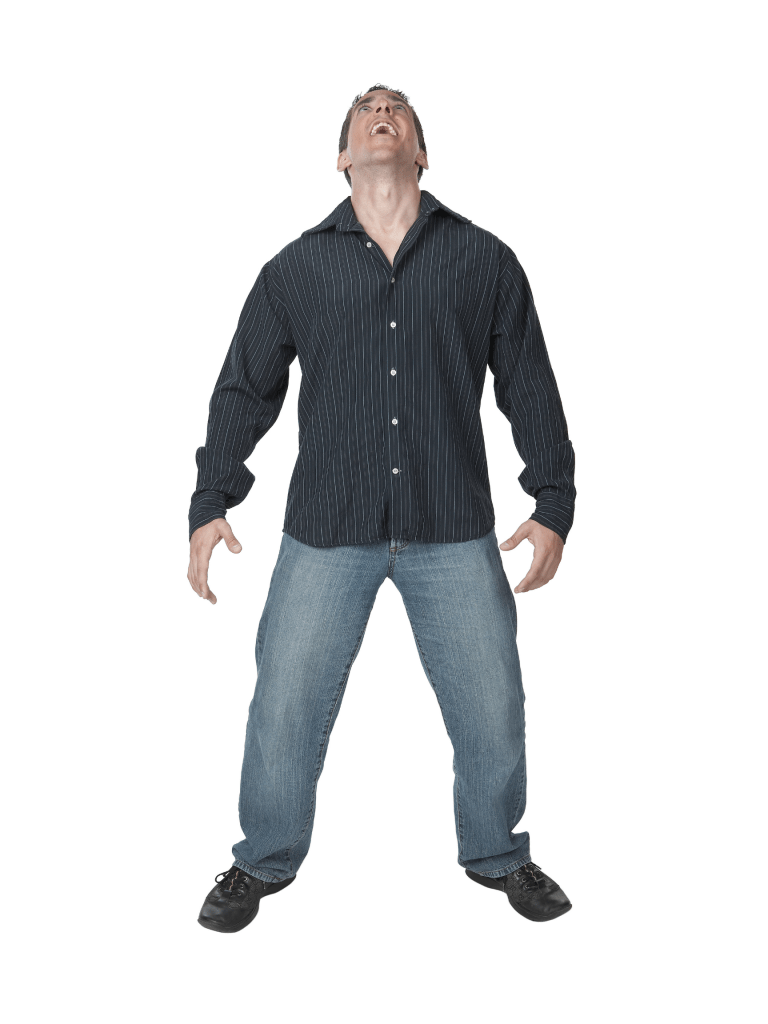
Oh boy.
Would you build a tower from the top down? If the tower was leaning and about to fall over would you fix the top block? Of course not! You’d start from the base, carefully stacking each block on its neighbor below until, finally, you reach the top. The same is true of our bodies. If your posture is terrible, you CANNOT cue yourself to fix it from the top. You must start from the base – get the feet under the hips, unlock the knees, and so on upward. By the time you get to your top half, you’ll probably find that the shoulders were never the problem in the first place. Just leave those poor shoulders alone! I’m sure your mother had many wonderful qualities, but her postural advice needs to go in one ear and out the other.
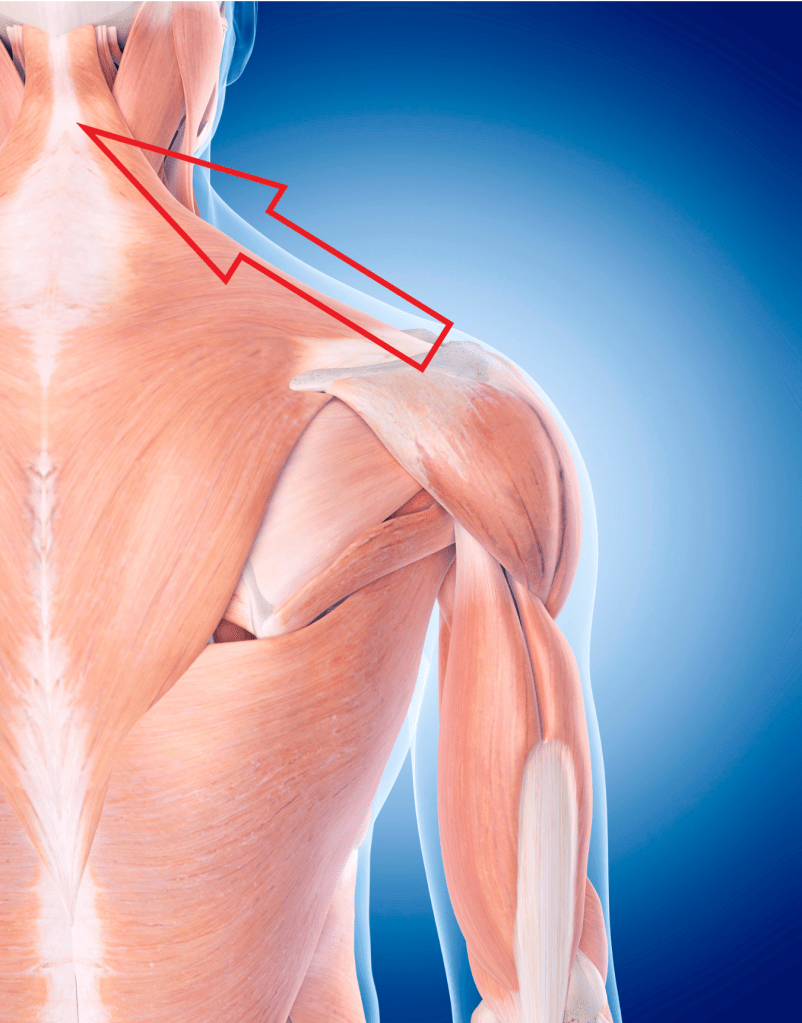
Now let’s say you’ve been walking around looking like that guy pictured above for years. Among the issues you may have caused is an imbalance in musculature – specifically at your shoulder blades. The interesting thing about the shoulder blades (I’m henceforth going to refer to them by their anatomical name – “scapula or scapulae (pl)” – is that they are almost entirely FLOATING bony structures. They sit at the back of the rib cage (thorax) and their only connection point to the rest of your skeleton is to the collarbone (shown below with a red arrow):
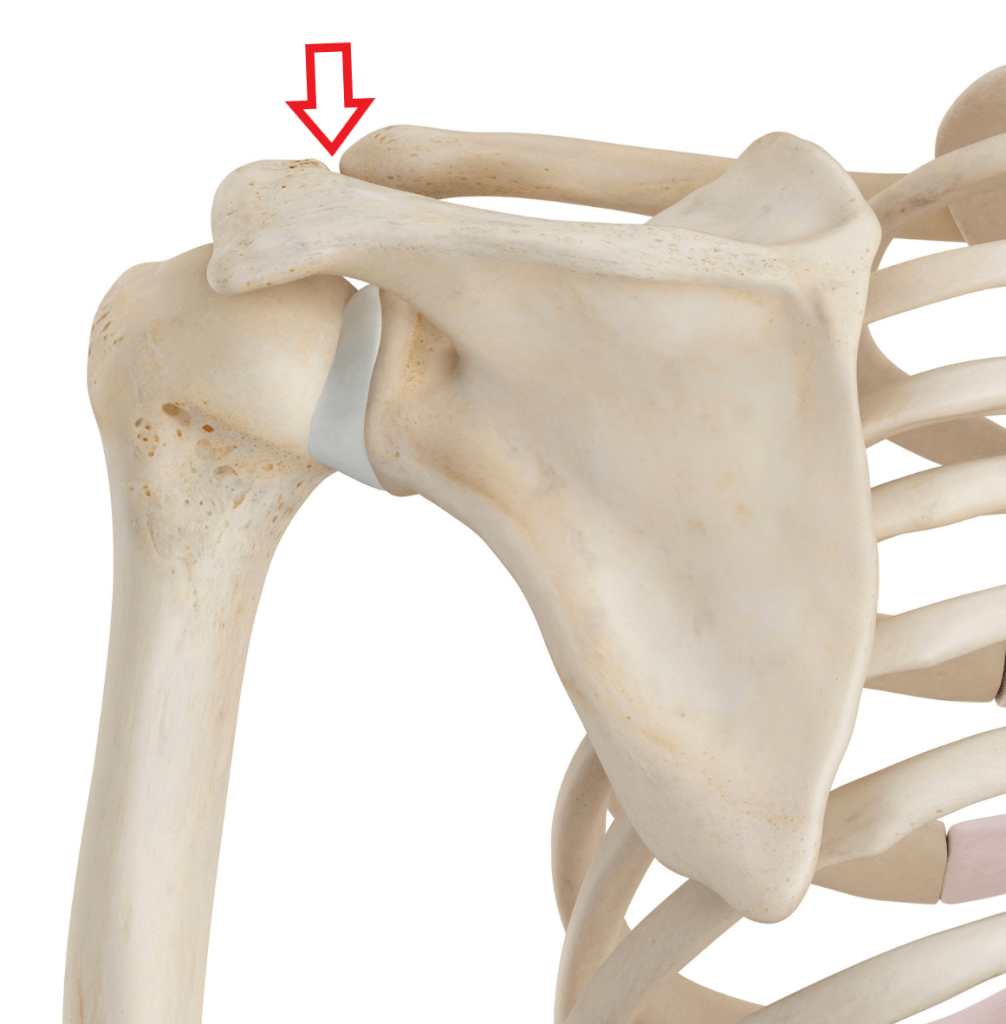
Scapula from behind
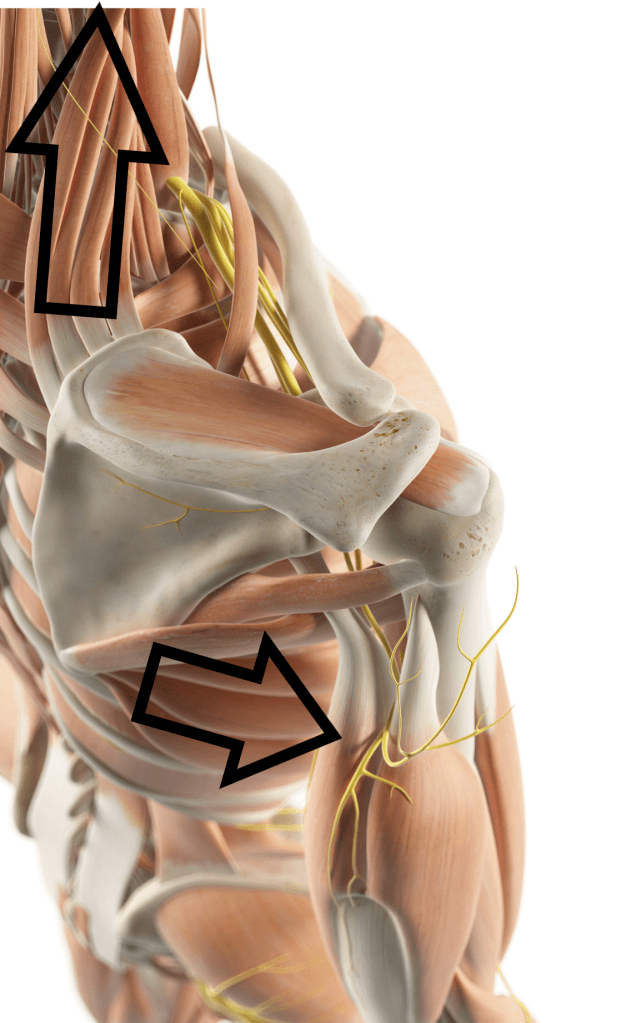
Given that the scapulae are not very “fixed” structures (meaning not well-secured to the skeleton), they really depend on the balance of muscles that surround them to hold them in the correct position and thus can be pretty easy to mess up! I would hazard to say most of us are walking around with some sort of scapular asymmetry. Here’s an example: 2 scapular muscles, the levator scapula and the serratus anterior, work to do opposite things to the scapula. The levator scapula, if not opposed by the serratus anterior below, would pull the inner corner of the scapula up, making the whole thing tilt precariously. If unopposed by the levator scapula, the serratus would do the exact opposite (though that’s extremely uncommon). I’ve placed arrows on the levator scapula (the topmost arrow) and the serratus anterior (the bottom arrow) to illustrate the directions they pull and how they need to work in perfect opposition to maintain the rotational position of the scapula:
Consider a real-life example: a person whose levator scapulae are winning the battle. In the picture below, this person’s scapulae have been pulled up at the inner corners, making the outer corners tilt downward – a position technically referred to as DOWNWARD ROTATION. His serratus anteriors are out to lunch. And the outward manifestation of this imbalance is that his shoulders appear low and sloped, and his neck looks long:
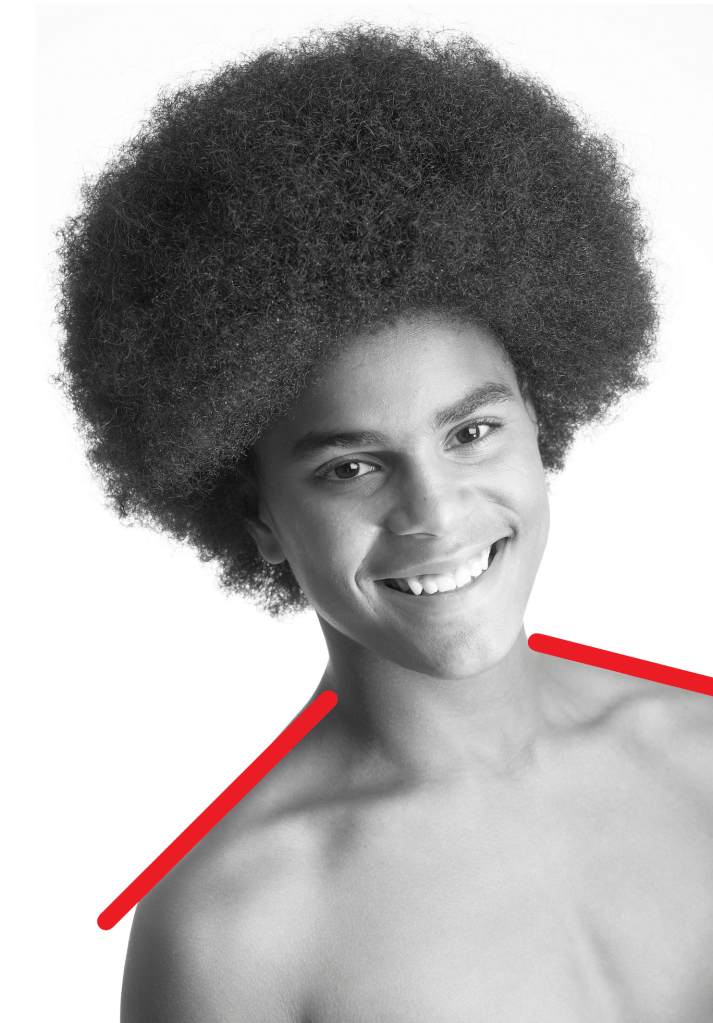
How did this situation come to be? Well there are a couple possibilities: 1) genetics – maybe his mom or dad had a similar alignment, and/or 2) he’s been taught that “good posture” means obsessively pulling his shoulders down toward his back pockets. If the latter is the issue, over a period of years his shoulders have slowly descended lower and lower and his neck has started to appear longer and longer.
This alignment, whether its underlying cause is genetics or habit or both, has two implications: 1) the weight of the low shoulders pulls down on the neck, creating neck pain, and 2) the narrow gap in which the rotator cuff lives gets even narrower, creating a pinching sensation in the outer shoulder area.
What’s the solution here? Enter…the oft-demonized helper to the serratus anterior….the UPPER TRAP!

But wait – you’ve been taught to HATE your upper trap’s. They hurt, and every massage therapist on the planet tells you yours are the knottiest they’ve ever felt, blah blah blah.
Consider this: what if the upper trap’s don’t actually deserve their reputation? What if they hurt because they’re struggling to do the job they were designed to do and we’re doing everything in our power (namely pulling our shoulders down) to make their job harder?

Well here’s what the upper trap is capable of doing if we let it: it can help that poor little struggling and failing serratus anterior to tilt the outer corner of the scapula back UP where it should be! Presto! That’s called a “force couple” – where two muscles work together toward the same goal. There are numerous force couples at the scapula, but this is my favorite.
A good rule of thumb is to never assume a painful muscle is painful because it’s SHORT and TIGHT. Sometimes a painful muscle is actually a LONG muscle that’s been pulled TAUT (note this is very different than tight) by the abnormal position of the bones. So maybe that’s why stretching the upper trap and getting it massaged in hopes of lengthening it hasn’t made anything better! Huh!
If you’re interested in figuring out if you have this problem, the easiest way to look at your shoulder levels is to look in a mirror without a shirt on and compare 2 points: point A is the end of your collarbone where it meets your breastbone (sternum), also called your SC joint, and point B is the other end of the clavicle, felt as a bony prominence at the top of your shoulder (also known as your AC joint):
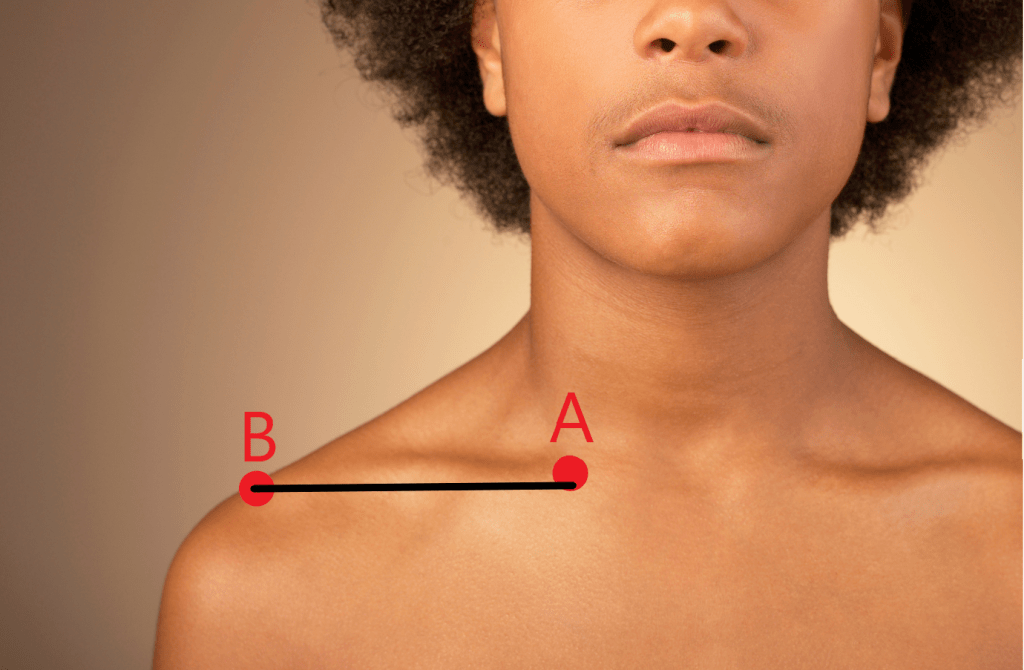
In normal anatomy, point B should be a bit higher than point A. Your collarbone should slope a bit upward as it moves away from your center. As you can see, this person’s clavicle is fairly level or may even have a bit of a downslope. As a result, he’s a prime candidate for the neck and shoulder issues to which I just referred. He needs to be doing exercises to strengthen and – yes – SHORTEN his upper trap’s and serratus anterior to restore more normal shoulder height. Yikes – is it possibly EVER a good thing to make a muscle shorter and tighter?! Absolutely. And can these kind of things actually be accomplished past age 12? Again, absolutely. It takes time, but I’ve seen prime examples in my most obedient patients who dedicate themselves to 1) discontinuing the bad habit of pulling the shoulders down, and 2) regularly doing exercises that I prescribe to shorten the upper trap’s and the serratus anterior.
At the risk of diving too deep, I would feel remiss if I didn’t also briefly look at the shoulder blades from a different perspective: a birds-eye view. As I mentioned above, the scapulae float right on top of something that is round: your rib cage. As a result, they situate themselves in a position where they are somewhat turned in toward one another – generally by about 40 degrees. In the picture below, I’ve drawn 2 lines: one line represents where the scapula should ACTUALLY sit, turned in to contour the rib cage beautifully. The other lines represents where the military or our mothers THINK our scapula should sit.
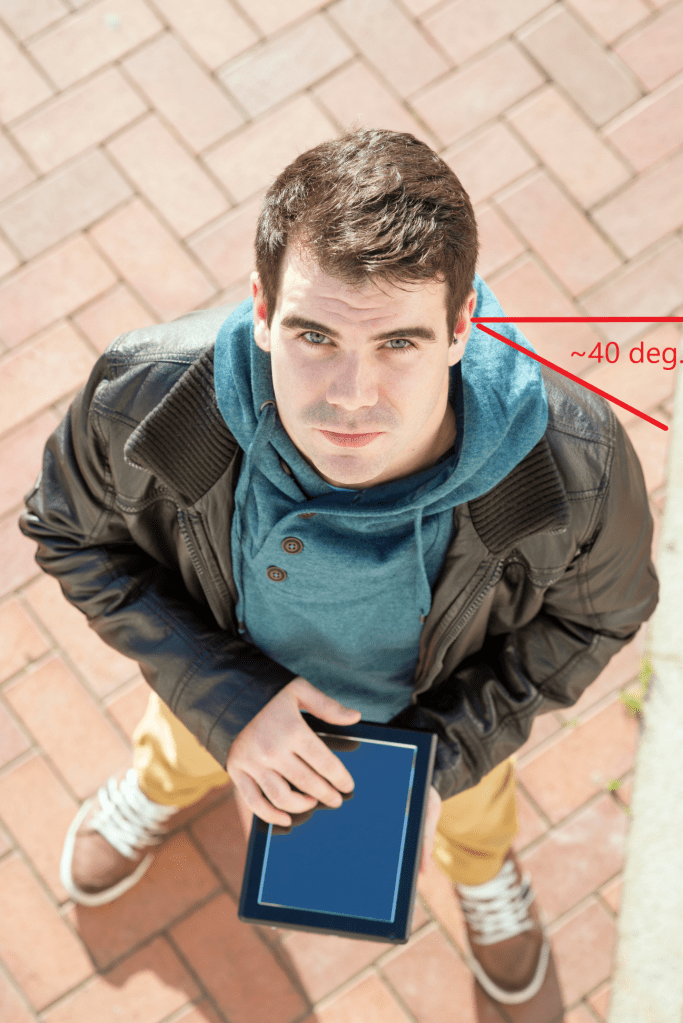
If you’re someone with the habit of pulling your shoulder blades forcefully back and together with the false notion that they should form a straight line and not contour your rib cage, you are paving your own road to pain with good intentions. And if you’ve ever suffered from pain at the front of the shoulder, often diagnosed as “biceps tendinitis”, this may be the root cause.
Have you identified yourself in anything I’ve just discussed? If so, I would always suggest that you get yourself to a really good physical therapist. You could try to fix yourself with the Google machine, but that can be a dangerous road to go down and you may make a mistake that takes you in the exact wrong direction. There is a reason that most PT’s out there have doctorate degrees – they have spent a LOT of time learning about the body. They have spent countless hours in school studying the science of movement (kinesiology) and biomechanics. They have performed cadaver dissections to look at the bones and muscles in 3D and really understand how everything hooks together. The act of analyzing and optimizing movement is an ART – not a formula – and it really does take years of practice.
What’s more, when you go see your PT, they should not just be doing a comfy cozy ultrasound on the front of your shoulder. You deserve more than a modality that may give you 10 minutes of relief at best and, at worst, no relief at all. Your PT should be educating you on the underlying cause of your pain, suggesting positions for rest and relief and very targeted exercises to strategically rebalance your musculature.
To be perfectly honest, though, shy of prescribing specific exercises or doing fancy manual work, most of the fix lies in just STOPPING the bad habit. If you continue the bad habit of pulling your low shoulders down or yanking them forcefully back, the pain will always be under the surface lying in wait even if you’re doing the exact right exercises. The minute you think you’re cured and you decide to stop your home program, BAM – the symptoms will return. It may sound overly simplistic, but once I’ve identified someone’s problem, the best thing I can do for them is tell them what they need to STOP doing. I could do nothing else in that first visit and the patient will come back for their second feeling a bit more empowered and with substantially less pain.
So let’s stop the unnecessary and unfair demonization of the upper trap’s! Let’s stop pulling our shoulders down and back and start respecting their rightful place a little closer to our ears!

 The Movement Mama